
Conversational AI vs Chatbots: What’s the Difference?
Understanding the difference between conversational AI and chatbots is important in today’s digital world. Many people think they are the same. But they are not. Both are used for communication. However, their capabilities are very different. This article explains the difference in a simple and clear way.
For readers who want to understand the technology behind language-based systems, this Natural Language Processing guide provides additional information.
What is Conversational AI?
Conversational AI is an advanced technology. It allows machines to have human-like conversations. It uses natural language processing and machine learning. These technologies help systems understand and respond naturally.
Conversational AI can understand context. It can remember past interactions. It can also learn from conversations. This makes it smart and adaptive.
It is used in voice assistants, smart devices, and advanced customer support systems. It can handle complex queries. It gives more accurate responses.
What are Chatbots?
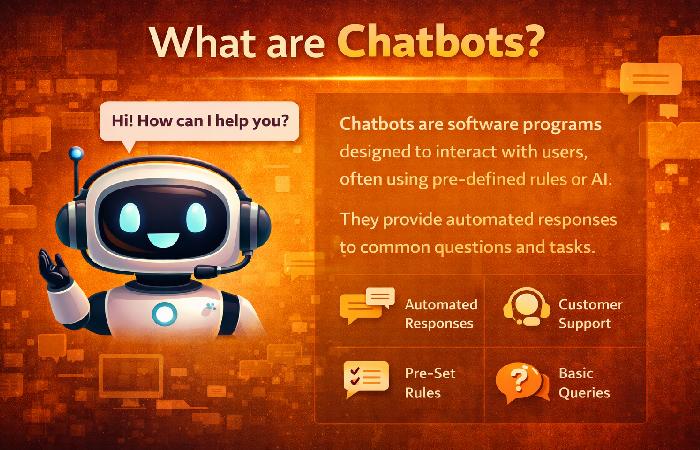
Chatbots are simple programs. They are designed to interact with users. They mostly follow pre-defined rules. They respond based on keywords or commands.
Basic chatbots cannot understand context well. They give fixed replies. Some advanced chatbots use AI. But many are still rule-based.
AI vs Chatbots: Key Differences
| Feature | Artificial Intelligence (AI) | Chatbots |
|---|---|---|
| Definition | A broad technology that enables machines to think, learn, and make decisions | A software tool designed to simulate human conversation |
| Scope | Very wide and includes multiple technologies like machine learning and deep learning | Narrow and focused mainly on communication |
| Function | Performs complex tasks like data analysis, prediction, and automation | Handles user queries and provides responses |
| Learning Ability | Learns and improves automatically using data | Basic chatbots do not learn; AI chatbots can improve |
| Complexity | Highly complex systems | Simple to moderately complex |
| Human Interaction | Not always required | Always requires user interaction |
| Usage Areas | Healthcare, finance, education, automation, robotics | Customer service, websites, apps, support systems |
| Decision Making | Can make intelligent decisions based on data | Limited decision-making ability |
| Technology Used | Machine learning, deep learning, neural networks | Rule-based systems or AI-based NLP |
| Cost | Expensive to develop and maintain | More affordable and easier to implement |
| Flexibility | Highly flexible and adaptable | Limited flexibility |
| Examples | Self-driving cars, recommendation systems, fraud detection | Website chat support, virtual assistants |
Advantages of Conversational AI
Conversational AI improves user experience. It gives accurate and relevant answers. It can handle complex queries. It also saves time.
It works 24/7. It can manage multiple conversations at once. It also keeps learning and improving.
Advantages of Chatbots
Chatbots are easy to use. They are cost-effective. They are quick to deploy.
They are useful for simple tasks. They reduce workload on human staff. They provide instant responses.
Limitations of Conversational AI
Conversational AI can be expensive. It needs large data to work well. It also requires skilled developers.
Sometimes, it may still misunderstand users. It is not perfect.
Limitations of Chatbots
Chatbots have limited understanding. They cannot handle complex queries well. They depend on scripts.
They may give wrong answers if the input is unexpected. They also lack human touch.
Which One Should You Choose?
| Factor | Choose Conversational AI | Choose Chatbots |
|---|---|---|
| Business Size | Large businesses with complex needs | Small or medium businesses |
| Budget | High budget available | Low or limited budget |
| Complexity of Tasks | Handles complex and multi-step queries | Best for simple and repetitive queries |
| User Experience | Provides natural and human-like conversations | Basic and structured responses |
| Learning Ability | Learns and improves over time | Limited or no learning (rule-based) |
| Setup Time | Takes more time to develop and train | Quick and easy to set up |
| Technology Requirement | Requires advanced technologies like NLP and ML | Uses simple rules or basic AI |
| Customer Support | Ideal for advanced customer interaction | Suitable for FAQs and basic support |
| Scalability | Highly scalable for growing needs | Limited scalability |
| Maintenance | Requires ongoing updates and training | Easy to maintain |
| Best Use Case | Virtual assistants, healthcare, banking | Website support, simple queries |
Comparing Chatbots vs. Conversational AI for Customer Service
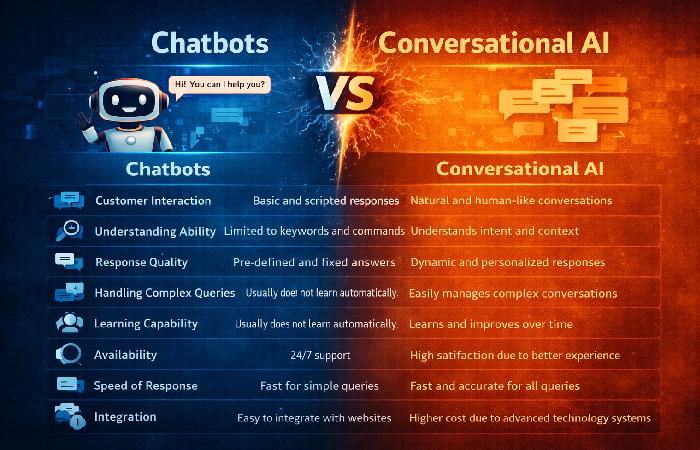
The distinction between these technologies is also important when evaluating conversational AI vs. chatbots for customer service and digital communication.
| Factor | Chatbots | Conversational AI |
|---|---|---|
| Customer Interaction | Basic and scripted responses | Natural and human-like conversations |
| Understanding Ability | Limited to keywords and commands | Understands intent and context |
| Response Quality | Pre-defined and fixed answers | Dynamic and personalized responses |
| Handling Complex Queries | Struggles with complex issues | Easily manages complex conversations |
| Learning Capability | Usually does not learn automatically | Learns and improves over time |
| Customer Satisfaction | Moderate satisfaction | High satisfaction due to better experience |
| Availability | 24/7 support | 24/7 support with better engagement |
| Speed of Response | Fast for simple queries | Fast and accurate for all queries |
| Personalization | Limited personalization | Highly personalized interactions |
| Integration | Easy to integrate with websites | Requires advanced integration systems |
| Cost | Low cost | Higher cost due to advanced technology |
| Best Use Case | FAQs, basic support, simple tasks | Advanced support, virtual assistants, customer experience |
Future of AI and Chatbots
The future looks bright for both technologies. AI is growing fast. It will become more advanced. It will be used in more industries.
Chatbots will also improve. They will become smarter. They will understand emotions better. Voice-based chatbots will become common.
The gap between AI and chatbots will reduce. More chatbots will use AI. This will make them more powerful.
The same AI technologies can also be applied across many other industries and markets, including specialized digital sectors such as the nicotine pouches market.
Conclusion
Understanding AI vs Chatbots is essential today. AI is a broad and powerful technology. Chatbots are specific tools for communication. Both have their own roles. Both are useful in different ways.
Businesses should choose based on their needs. For data analysis, AI is better. For customer support, chatbots are ideal. Together, they create a strong system.
Technology will continue to evolve. Learning these concepts now will help in the future. AI and chatbots are not competitors. They are partners in digital growth.
For additional information about artificial intelligence and conversational technologies, readers can also explore the IBM overview of conversational AI.